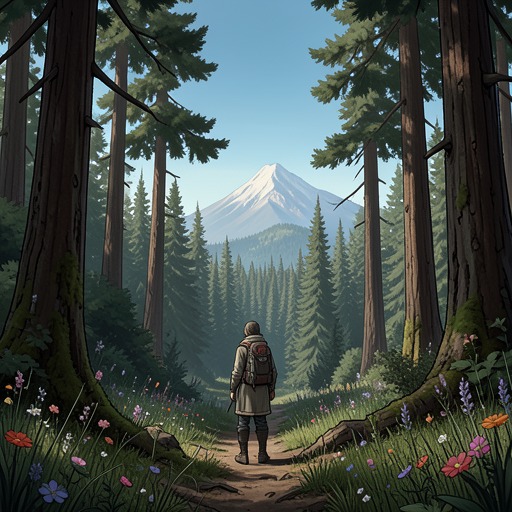
Abusaroka Mountains
Happiness for BeginnersThe Absaroka Mountains are the destination for the BCSC group’s three-week wilderness traverse and the setting in which Helen learns that Jake is losing his sight. Introduced as a place of punishing terrain and strict expedition rules, the range becomes more than a test of endurance: its miles give shape to the journey Jake has continued while carrying knowledge that his future is changing irreversibly.
Destination and Reputation
At the group’s orientation, Beckett identifies the Absaroka Mountains as the opposite of Disneyland and teaches the participants how to pronounce the name. He presents the range as one of the steepest and wildest in the country, warning that it can overwhelm the unprepared. Helen privately wonders whether the alarm is warranted or whether Beckett is trying to reassert his authority; the other participants, in contrast, are captivated by his increasingly frightening presentation. The mountains therefore enter the story through a contest between the instructor’s dramatic warnings and Helen’s skepticism, even as the group prepares to follow his rules.
The Three-Week Traverse
Beckett traces the planned route across a map, marking a journey that will last three weeks. The group is to hike together every day, cover six to twelve miles daily—including steep, vertical stretches—and sleep in tent groups of four. At camp, participants must set up their sleeping tarps before their kitchens; the routine is presented as part of the work of traveling through the range, not as an optional comfort.
The expedition’s preparation makes the limits of life on the trail concrete. Participants are permitted one small camera, one spare T-shirt, one spare set of socks, one spare pair of underpants, and a single book for entertainment; a notebook is required as a journal. They must pack their own bags according to the company’s system, and Beckett forbids shampoo and deodorant as needless weight. Before setting out, the group is directed to collect any remaining gear, fill their packs, eat supper, and take a final shower before their last night in a bed. The mountains are thus approached through a deliberate transition from ordinary routines to restricted, shared expedition life.
Jake’s Disclosure on the Trail
The range also forms the setting for a conversation that changes Helen’s understanding of the person beside her. Jake explains that he first canceled the trip because he was having trouble with his eyes; examinations and tests revealed an inherited vision disorder that could not be fixed. Night blindness is one part of it. He says he has spent the past year searching for information and has concluded that all he can do is wait for the light to go out.
The diagnosis recasts the physical journey. As Helen realizes, Jake has carried this knowledge through the hikes while the group—including Helen—complained about blisters, misunderstandings, and ordinary discomforts. The mountains’ exertion does not cause or cure his condition; instead, the landscape’s long miles sharpen the contrast between the visible hardships shared by the group and the private future Jake cannot escape. His father’s nickname for him is Doc, and Jake understands that his father sees the high-achieving, hard-working son he intended him to become. That expectation hangs over the loss of the future Jake had imagined for himself.
A Landscape of Desired Futures
Jake’s account is not only a list of losses. He tells Helen about things he still hopes to see, including his childhood home and the merry-go-round at a park his grandmother used to take him to. He is also considering a trip to Texas to look through his father’s historic family photographs. His ambitions include experiences as well as sights: scuba diving, driving a race car, and riding the world’s scariest roller coaster. The contrast between these plans and the mountain trek gives the journey a double meaning: Jake is moving through a landscape with Helen while confronting the possibility that future sights and experiences may become inaccessible.
Later, Jake explains that after the diagnosis became certain, his imagined future seemed to disappear. He had wanted to become a doctor, have a large family, and learn to scuba dive; when he understood that his vision would progressively fail, he could not breathe or eat. His fear is explicit when he tells Helen that in the next few years his eyes will go dark and nothing can change that. The mountains are not the source of this crisis, but they are where Helen sees how completely Jake has continued the expedition while carrying it. In that way, the Absaroka Mountains bind the group’s shared ordeal to the intimate revelation that changes what the journey means.